T i f f a n y H s u

Showing posts with label Education. Show all posts
It's been just over a month of taking courses online and I've learned a lot!  I went into this past month trying a bit of everything.  Not everything worked out, but overall I really enjoyed the majority of the courses I took.

I've discovered I'm really an auditory and visual learner.  Just reading about a topic doesn't have the same affect for me as watching a video.  For example, I've been wanting to learn more about the stock market for years.  I have previously invested my money into stocks and had some luck, but I never quite understood how to make better choices.  So I started with a very basic course to get an overview of the stock market, then advanced into technical trading, and I just bought a third course about options trading.  I haven't started the third course, but after the course on technical trading I have a better understanding about risk management (I think anyone interested in the stock market really should start with risk management), how to invest, how much to invest, when to invest, and when to sell.  Of course there is much more to learn, but being able use and read charting software has made learning about the stock market much less intimidating.

Another skill I've always wanted to learn is how to use Photoshop.  I decided on adding a free Photoshop course to my Udemy classes and was pleasantly surprised about how useful the course is.  I've been taking Photoshop & Lightroom For Beginners and I like that the instructor, Yanik Chauvin, has broken up the topics by the end result rather than go over what each tool does.  I had a separate course on Adobe Illustrator where the instructor just went over the tool panel, but that was nowhere near as effective as learning how to use the tools together while having an end result in mind.

That brings me to an observation.  I found the courses that taught tangible skills to be more interesting and useful than courses that focused on theory and idea.  I had a whole three and a half years in university that just went over theory, which is a great foundation to have, but now I'm much more interested in learning skills.

Another observation specifically related to choosing courses on Udemy is that a lot of the free courses are actually good, sometimes better than the paid courses.  I took two different logo making courses and I found the free course to be much more useful and relevant than the paid course.  This is also true of the high priced versus low priced courses.  The higher price doesn't indicate better quality, but rather those courses employ the marketing technique of creating more perceived value of their information by placing a higher cost.  The same goes for reviews of a course, I've noticed a lot of "friends" of some instructors create fake reviews, so as with any user generated review site, use your judgement.  Better yet, if the course offers a free preview, watch those videos to see if the course style, topics, and instructor make sense for you.  There have been courses I returned because I just couldn't get myself to pay attention to the instructor's teaching style.

Udemy had another $10 sale, which was a perfect opportunity to add more courses to my list.  It's really addicting learning new skills!
I am really having fun learning Photoshop.  The lessons I've been taking are really showing me how little I really knew about what Photoshop can do.  It really is true what is said about Photoshop, there is a steep learning curve, but once you start to learn, it becomes fun.

Here are two photos from my trip to Ireland's Cliffs of Moher from 2011.  The first photo is fine, but it could be a lot more fun. The second image is way under exposed, but the ray of sunlight coming from the clouds is beautiful.


I wanted to see if I could do something with the two photos, after seeing a tutorial on how to merge photos in Lightroom, I decided to give it a try in Photoshop since I am a bit more familiar with using layers.

Voila!


Not a bad first try, but I'm hoping to make it better as I learn and practice.  I don't think I'll be merging my photos often, but I love learning how it's done!  It's like when you learn how magicians do their tricks.

Here's another photo I did.  The before of the Taj Mahal lacks detail in the sky.  Adding a few clouds makes the photo more interesting -- almost like an HDR phoot


I've added more photography courses to my Udemy list, and it's helped me learn more by diversifying who I learn from.  The Photography Masterclass has been helpful in making manual mode so easy that I haven't moved my camera dial away from manual ever since, but I didn't want to rely on one course.  It's paid off since I've been picking up a lot of tips and tricks.

For example, when taking a backlit photo try to take the photo against a darker background to accentuate the light around the subject.  Not a life changing tip, but something I probably wouldn't have paid much attention to.  

I also started a few Lightroom and Photoshop courses, which forced me to finally open up and install the copy of Lightroom I bought years ago, but never got around to using.  Today I learned about how to do selective color.  I still remember when I bought my first point and shoot, I thought it was so cool to take black and white photos with one color highlighted, but it never worked since it would leave blotches of color in places I didn't want it.  Using Lightroom is MUCH better. 

Here are just a few first attempts:


It's been a week since I started a course on improving memory and speed reading. The course I selected for this purpose is Become a Superlearner: Learn Speed Reading & Advanced Memory.

The research and methodology is lead by Dr. Lev Goldentouch and Prof. Anna Goldentouch, the course is taught by Jonathan Levi.  From the start you can tell that Jonathan Levi is influenced by Tim Ferriss, which works for me since I am familiar with his work.  For anyone who isn't, Tim Ferriss came into the public eye with his book, The Four Hour Work Week, which goes over the idea of lifestyle design with a heavy emphasis on automation and life hacking via the pareto principle (80/20 rule).

 I've only gone through half the course, but I am taking a break from the videos.  This isn't because of a lack of interest, but each of the concepts takes a lot of practice and can't be rushed.  I haven't had time to practice, so I don't want to skip too far ahead in the videos without building the right foundation first. 

The first half of the course focuses on improving memory.  It doesn't matter how fast you can read if you can't remember it.  

The Superlearner course starts with a baseline test for reading speed and retention.  My baseline was 287 wpm with only a 64% retention rate, yikes!  After a week watching the videos, my reading speed has gone up to 390 wpm with 100% retention!  Since everything from the last week has focused on memory, I was surprised to see even my reading speed increased.  

Even though my retention has gone up, I know I'm not using 100% the strategies the course goes over.  Old habits are hard to break.  After each video I try out the methods taught, but after some time my head starts to hurt since some of the ideas are counter-intuitive to how I was taught to read.  It just goes to show that reteaching our minds is like working out muscles in the body.  It's not easy at first, but as you practice, momentum starts to build.  

The course focuses on using images as a way of  taking information from the working memory and storing it into our long term memory.  One of the first things the course goes over is making memorable images that are related in order to remember information in a text.  As you are reading, you create memory markers that connect and store information from the text. This doesn't come naturally for me.  

This is the stripped down version of what the first half of the course goes over.  There is more information that I'm not including, so if you are interested in speed reading, I recommend the course. So far I am enjoying it and I find the information to be useful. 

I'll end this entry with a video about the US memory champion, Nelson Dellis as motivation:


If you read some of my other posts about online education I'm sure you've noticed that I really like taking classes on Udemy.  One of my favorite classes that I am currently taking is the Photography Masterclass: Your Complete Guide To Photography taught by Sam Shimizu-Jones and Phil Ebiner.

From taking a lot of beginner classes I'm realizing that in the past I tended to jump into a part of a topic that interests me while not really learning the fundamentals.  This has proven to be very limiting.  With photography I already knew how to manipulate some things to achieve what I wanted my photo to look like, but I still found shooting on full manual mode very daunting. I've read books, websites, photography magazines, but this is the first time the concepts and practical applications of how to utilize the skills has really sunk in.  I guess I'm more of an auditory learner than I had thought!

Sam and Phil have really put together a very easy to follow comprehensive course that covers the beginner basics and more advance topics.  Each video focuses on a different topic and shows the practical application of the concept.  The videos are very short, so you learn about the topic and then you are encouraged to go out and put the concept into use.

The very beginning of the course goes over how a camera works and the different types of cameras out there.  Nothing too intense, but good to watch just to get used to their teaching style.

For me, the real meat of the course is in the 3rd section which focuses on dropping auto and learning manual.  The absolute best takeaway from that section is their video and diagram of the exposure triangle.  I always wondered how to evaluate whether to adjust ISO, Aperture, or Shutter Speed, honestly, not being sure how to balance them is the main reason I stayed away from using full manual.  I have seen the three represented together as part of the exposure triangle in the past, but I don't know why it didn't click until now.

The main takeaway is to remember that even though all three help determine how much light reaches the camera's sensor, they each control a different aspect of the final photograph.  The below are pretty basic, but for me it was a good reminder of what to be thinking about when deciding what to adjust.

The ISO will determine how grainy the picture is, the higher the number, the more light and the more grain.

How you set the Shutter Speed determines whether or not your image will be sharp or include motion blur.

The Aperture controls the depth of field, the wider open the aperture (smaller number) gives more of a shallow depth of field while a deeper focus is achieved as aperture becomes more closed(larger number).

For a beginner getting used to shooting in manual mode, when evaluating a shooting situation, determine what kind of look you want for you images and adjust two of the settings to what you think should achieve that look, then as you are shooting, adjust the third to gain the correct exposure.  For example, if I am shooting outdoors in the sunlight, I may determine an ISO of 200 works for the situation.  I know I want to isolate my subject and decrease my aperture to 1.7.  Then as I am shooting, I would adjust my shutter speed to make sure I have the correct exposure.

The second bit of knowledge that I gained from that section is how to utilize the camera's light meter to determine if the chosen settings will over expose or under expose the photograph.  I know this makes me sound like a complete photography incompetent when I say this, but just those two parts of the class have really completely changed how I see manual mode.  I actually now prefer it to any other mode on my camera!

Just that bit I wrote above has taken manual mode from something complicated and scary to something enjoyable.  As with everything, knowing the basics isn't enough, but practicing the technique builds skill.

Below are just a few shots I've taken trying to get correct exposure.  I'm already seeing a difference in how I can change the look of the photograph based on how I change the settings.

Just for reference, these photos are taken with the Panasonic GF7 with the Lumix 45-150mm f/4-5.6 lens.


I find taking some of the free courses on Udemy to be fun diversions.  Without committing too much time, you can take a short free course on topics you might not have considered learning about.  Best case scenario, the course is helpful and introduces you to a topic you find out you enjoy, worse case scenario, you spend half an hour on a topic that you discover you really don't like.  Most likely scenario, you learn something new or reinforce what you already know.  Most of the free courses are pretty short and focus on a handful of concepts along with a few applicable ideas.  The most recent one I watched was Simon Jack's "Skool Of Creativity: Essentials".

The videos total at just over twenty minutes with a few text assignments.  The idea behind the course is to help viewers think more creatively with an emphasis on using that creativity to design solutions.

From the exercises, one that I find myself using from time to time is choosing an object and then think of 10 uses for it.  The uses can be practical or silly.  For example, a fork.  It can be used to eat with, it can be used as a name card holder, it can be used instead of a rake in a miniature garden, etc...  There are a few other steps in the exercise, but I won't give those away.  I've found doing this exercise on a regular basis helps prime my mind into thinking of different possibilities, which makes it less rigid in thinking.

Another concept Simon talks about is redefining a problem to find new and different approaches.  Sometimes it is the way a problem is defined that is what keeps someone stuck, but when you reword the problem it helps to come up with new ideas.  The example he gives is an executive asking his workers what he can do to make them more productive.  When the executive reworded it as, "what can I do to make your work easier" there was more of a response from the workers than from the original question.

One final idea that I really liked is to take the perspective of someone else.  Choose a character or a real person and try to think how they would approach a situation based on their background, way of thinking, behavior, etc...  This gives you a new way of looking at a problem that can be different from your default approach.

There are other ideas Simon talks about, which makes the videos well worth watching.  I'm actually leaving it on my dashboard to refer back to sometimes when I need a reminder of how to think more creatively.  
In the spirit of learning new skills and increasing my knowledge about things I've always been curious about, here's a great video about learning.  Josh Kaufman has found that in order to learn a subject, going from no knowledge on a subject to being competent takes about 20 hours.  That is equal to roughly 45 minutes a day for 1 month with a few days to spare.  That's a pretty grounded idea that when learning new skills, give it a month with focused learning 45 minutes a day to get to the point where you feel like you know what you are doing well.  Not expert level, but well.  That's pretty cool.  It's similar to the idea that it takes 3 weeks to make something a habit, I'm sure there is research that shows why the similarity between the two ideas.

Of course as with learning any skill, just spending time doesn't make it effective learning.  It takes deliberate use of that time that really counts. See the rest of what Josh mentions below in his TedxTalk.

I've been in a learning kick lately, so I've challenged myself to sit down and learn some of the skills I've always meant to learn.  I took a few online courses for fun a few years back, but never really got into them, probably because at the time the courses were limited to a lot of introductory courses or very coding/programming specific.  But now online courses have really grown and I'm finding sitting down and watching these videos actually helps me learn much better than doing it all on my own.

First a few resources:

Coursera: Probably the most widely used and comprehensive MOOC (Massive Open Online Course) list of classes offered by various institutions of higher learning.  The classes are free to audit, with the option to pay for a certificate of achievement for completing the lectures and any assignments/tests associated with the course.

Class Central  and Mooc List: Both are aggregates that compile different courses from various websites.

MIT OpenCourseware:  Access to hundreds of MIT courses in a number of disciplines.

Udacity: This one is tech industry specific, offering what they call "nanodegrees"  or credentials for different programming languages and other skills tech employers are looking for.  Many of the nanodegrees are sponsored by various companies with collaboration from other companies.  So you may find a course created by Microsoft with collaboration from AT&T.

Udemy: Similar to Udacity, the courses in Udemy are more skills based rather than theory based.  Anyone can be an instructor, so they are effectively crowd-sourcing education.  This is probably my favorite for learning a new skill or delving deeper into a subject not normally covered in university courses.  The fact that anyone can be an instructor might put some people off, but since courses are reviewed by those who have taken the course gives instructors incentive to make their courses better, more helpful, and even entertaining.  The cost of courses range from free to a few hundred dollars, but I've noticed Udemy has promos all the time, which can make a course priced at $299 end up being only $10.  If cost is prohibitory, wait for these promos and then stock up on courses.  Once you have purchased the course they usually give you lifetime access to the material so there is no time limit.

One of the first courses I would recommend for anyone starting out is "Learning How To Learn" via Coursera and offered by the University of California, San Diego.  Barbara Oakley is the lead instructor and she's very interesting to learn from.  Her style is not dull or dry, but rather engaging. The course does skim some of the concepts of how our brain functions, but it mainly focuses on skills we can use to become better learners.  It's been some time since I graduated from university and having a quick reminder course about learning has really helped put me back into a learning mind-frame.

Some of the coures I'm currently taking include photography, photo editing, writing, and speed reading.  One of the tips from Barbara Oakley's course regarding learning is to try and recall what you have learned and also teach others, so I'm going to try and go over what I learn in subsequent posts.


The other day Daniele and I were talking about languages as we let ourselves get distracted from our task at hand.  We sometimes go over the Michel Thomas Mandarin lessons together as we've found it useful for me to explain or clarify certain parts of the lessons.  Before long I sent him a link to one of my favorite sites for language introduction, the BBC Language page.  I was happy to see they've expanded past the usual romance languages and now include many of the world's major languages.  We got a kick out of each language's language fact page, zeroing in especially on tongue twisters, longest words, and false language friends (words that sound like something words in English but have a completely different meaning).  Another fact we liked to see for each language was the jokes section, it's interesting to take a peak at how each culture looks at humor.

Here are a few facts from the BBC, check out their page for more language lessons, who knows, you may find yourself in love with learning about a language you never considered before.

FRENCH

The French would probably tell you their longest word is
anticonstitutionnellement, a long adverb meaning ‘in a very unconstitutional way’. It contains 25 letters but is hardly ever used!


In a foreign language, you can easily find yourself in embarrassing or funny situations. For example, if you want to thank someone, you could say Merci beaucoup, Thank you very much. Take care with the ou and try not to pronounce it u, otherwise you could be complimenting somebody on their ‘beautiful bottom’!


ITALIAN


If you ask Italians, they would probably tell you that the longest Italian word is precipitevolissimevolmente, extremely quickly, with 26 letters


Arguably this is the most difficult tongue twister in Italian:
 Trentatré trentini entrarono a Trento tutti e trentatré trotterellando
Thirty three people from Trento entered the city, all thirty three waddling


If you’d like pepperoni on your pizza, don’t be too surprised if you end up with peppers instead. The Italian word peperoni is the plural of  peperone, which is a pepper, so to make sure that you get the spicy sausage that you’re after, ask for  salame piccante


CHINESE


This is a great tongue twister for practising the tones, which are marked above the vowels. (I remember this from my childhood!)


 吃葡萄不吐葡萄皮,不吃葡萄倒吐葡萄皮。
Chī pútao bù tǔ pútao pí, bù chī pútao dào tǔ pútao pí.
When you are eating grapes, you don’t spit out the skin, but when you are not eating grapes, you do spit out the skin.


ARABIC 


Tongue twister


   مشمشنا مش مشمشكم ومشمشكم مش مشمشنا، لما مشمش مشمشكم، ما كان مشمش مشمشنا
[Mishmishna mish mishmishkom w mishmishkom mish mishmishna, lamma mashmash mishmishkom, ma kan mashmash mishmishna.]
Our apricots are not the same as your apricots, and your apricots are not the same as our apricots. When your apricots were ripe, our apricots were not ripe yet
Via Libraryinjonesboro.org

I was listening to a report about how many of the fast paced programs geared towards children are suspected of doing more harm than good.  As opposed to shows with a slower pace and emphasis on repetition that has been showed to increase comprehension.  An example of a show that I remember studying (I can't recall if I studied it for a child development class or for my own knowledge years later) is Blue's Clues.  Though to an adult viewer, there is nothing more dull than watching such a slow paced show, it has meticulously created using what researchers know about early childhood learning to be more conducive to child development. 

With that in mind I thought about what my favorite programs were when I was a young child.  I never missed an episode of Mr. Rogers' Neighborhood (perhaps this explains my love of cardigan sweaters) and Shining Time Station (ah, now I understand my adoration of trains), especially their juke box band segments.

While showing clips from Youtube to my Italian boyfriend, I was reminded of a commercial I would see constantly growing up.  Anyone else remember Muzzy?  It was a language learning program for children created by the BBC.  While watching the clips on Youtube my boyfriend and I quickly had stuck in our heads the songs for learning French vowels and French numbers.  Très amusant!  Check out the commercial below...ah what fun to take a trip down memory lane.


Via Wikipedia

While I was driving the other day I heard an advertisement for an online program created to help teach children geography.  It sounded like the pretty standard "virtual exploration" most of these programs consist of, but it made me wonder how effective these programs actually are.  Then I thought about how I was horrible at geography when I was younger, for some reason it just didn't seem relevent to me and so I lost interest in it.  There isn't anything about geography that is especially uninteresting, but I think it was in the way it is taught that didn't work for me.  I didn't actually learn about the world until I started traveling, and I'm not saying travel is necessarily the answer, but it was what I did prior to a trip that really taught me about geography.  During the trip planning process I explored different itineraries based on my budget, interests, nearby locations, and special promotions.  I went from not knowing anything about geography to being able to locate all the countries in Asia, most of Western Europe, North and East Africa, the Middle East, and North America (ok, that one is especially easy) on an unlabeled map.  Why those regions?  Simply because I planned trips to each region, I didn't necessarily travel to all of them, but the simple act of connecting something relevant for me to the location of different countries taught me more in a short time than a traditional geography lesson.

So how does trip planning translate into geography education for children?  What about having children gather into groups and give them a fake budget to adhere to as they decide on a travel itinerary.  The class can choose a theme or each group can have their own theme as to avoid too much duplication in itineraries.  Each group then plays around with actual travel booking sites, making it more real world relevant, for pricing and travel routes.  Then for the countries they "visit", each group member must research a topic of their choice and then come together to create a presentation and visual.  After each presentation, the class can vote on a winning itinerary based on cost effective use of the budget, number of countries visited, most interesting trip, etc...

It simulates actual trip planning which makes learning about the world more relevant.  The problem I had with learning about geography as a child was it was so far disconnected from my world that it was hard for me to actually imagine how the pieces fit into a whole.

Lately I've been reading a lot of Agatha Christie mysteries and I marvel at the logical way she planned out her novels.  Since I was curious, I read a little of her biography and found out her father taught her math by giving her word problems, training her mind to think logically about how to solve a problem.  Perhaps there is a correlation between making education relevant and matching how children learn.


I love languages.  Though I am not a polyglot by any means, I love learning about the subtle ways language frames cognition.  Call it my nerd personality, but there is such satisfaction in understanding how a language works(same with religion, same with culture, same with just about everything), the way a culture thinks is greatly influenced by language and communication, and vice versa.

Our world view is colored by the words we have to describe it.  An example is how children's cognition changes as they develop language skills.  To go from, "I love dogs," to "I love the way my dog runs to greet me, the excited way he wags his tail, and the look of overabundant joy that enters into his eyes whenever he knows I am around."  Having a way to describe those thoughts gives more notice to the reasons why someone may love their dog.  To have the words to describe gives our brain the ability to recognize (which came first is still a debate).

With that in mind, when looking at other languages, the world view of a given culture can be found in the words they emphasize versus the words they lack.  When I lived in China, after a month or two, I found myself switching between thinking in Mandarin and thinking in English.  The way I acted differed based on which language I primed my brain to think in.  When in Mandarin, I gave more of an emphasis on how people and things related to each other and to myself.  Which is no surprise as China has a culture that us centered around relationships.  In English, well, it's harder to say exactly, since I think of English as my modus operandi.  Even now, back in the States, it's not uncommon for me to think of the perfect phrase in Mandarin but not be able to convey the correct meaning in English.

For example, the phrase for "goodbye" in Mandarin is, "zhi jian."  Which literally translates to, "see you again."  This gives the idea that to leave is not permanent.  In Arabic, "ma salama" for goodbye translates into "God be with you."  Giving the learner an insight into how heavily religion influences Arabic language.  It also has nomadic connotations.

Then there's getting into the written language which adds another dimension into how things are viewed.  For example, the character for "mother" is the same as the character for "horse" only with the character for "female" on the side.

Mom = 媽

Horse = 馬

Female = 女

This gives some insight into how traditionally the role of a mother was viewed.  If anyone finds themselves in Xi'an, China and you can drag yourself away from the Terracotta Warriors long enough (still one of the most breathtaking attractions I've ever seen), check out the Forest of Stone Steles Museum.  They have tablets that show the progression of Chinese characters.  I was interested because my dad  loves to talk about how the Chinese written language progressed from pictorial to symbolic. Really, once you get into the reasons for the symbols used in each word, it's hard not to see the Chinese as very systematic and logical when it came to creating language.  Some say Mandarin is all about memorization, but within each character there are clues to the pronoucation and meaning of each word or combination for phrases.

I know this just shows how much of a language nerd I am, but it's worth repeating, you can learn a lot about a culture based on how they use language, if there are variations used for different group of people, and the types of vocabulary they have, etc... Ok, language and food(really, if you think about it, with these two categories, you can learn so much about a culture including the type of climate they live in, their body composition, how they view the world around them, if they value community over individualism, how they view the elderly, children, and/or women, etc...) :)

And one more thought for all language learners.  If you find yourself using newly acquired language skills with native speakers who do not understand you, do not always assume it is the fault of your skills.  Keep in mind everyone is primed to have certain expectation when they meet strangers.  For example, when I lived in China, I met a very lively American woman who had been living in China for 10 years. Her Mandarin vocabulary was much more varied than my own, and I remember spending time cooking and debating the proper situations for the different variations for "pardon me"  (Dǎrǎo, Dǎjiǎo, Máfan, etc...).  Well, usually when we would take a taxi or talked to strangers in a restaurant or shop, she would speak in perfectly understandable Mandarin, but she would get blank stares and the stranger she spoke with would direct their attention to me and ask me what she said.  So keep in mind, if a person is not primed to expect a certain language to be spoken by someone, it makes it harder for them to be prepared to understand.  I've seen it happen when I tutored English in Spain, even watching my Italian boyfriend interact with my friends, or listening to him learn Mandarin is a reminder of how much priming affects comprehension.   Each time he visits me in California, he has to mentally prepare himself to listen to English.  And now with Mandarin, I need to warn him ahead of time if I am going to speak to him in the Mandarin he has learned, otherwise he doesn't comprehend words he already knows.

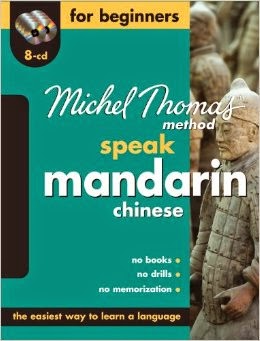
I've been helping my boyfriend learn Mandarin and we've been using the Michel Thomas method.  I used it before with Arabic and really liked how you learn sentence structure and from there can build on the complexity of the sentences.  He's almost done with all 8 Mandarin cd's and after spending many skype sessions going over the lessons with him and helping to clarify a few pronunciations and reasons for usage of one phrase over another, I think he has the sentence structure down pretty well.  It's what I love about Mandarin, it's pretty logical and there are few, if any, exceptions to rules.  He was doubting his progress with Mandarin, but I told him since he has a good grasp of sentence structure, he knows a good number of verbs and other basics, it mostly is a matter of learning vocabulary now.  After he gets through those basics of Mandarin, it is his choice whether or not he wants to continue on to learn the other more subtle nuances of the language.  But really, after a month of self taught language learning along with clarifications from me, he can pretty much just go to Google Translate to find the vocabulary he wants and create basic to somewhat complex sentences.

Idioms and subtle meanings, the correct way to approach the language based on situation and custom, now that's another story.

The basic sentence structure of Chinese is:

Subject - Time - Place - Prepositional Phrase -Object

A note on time.  Depending on whether you want to emphasize the time or subject, time can go before or after subject.

So a sentence like, "I want to go to Beijing tomorrow with my boyfriend" is ordered as, "I and my boyfriend tomorrow want to go to Beijing."

Whenever my boyfriend is confronted with more complex sentences, I remind him to break the sentence apart and follow the sentence structure and he always can find his way.
  • Older posts →

Welcome to my personal blog!
I post about things I want to remember, if it helps someone
else along the way, all the better.

Translate

Labels
  • Travel ( 77 )
  • My Life ( 45 )
  • Photos ( 39 )
  • Photography ( 18 )
  • China ( 14 )
  • Education ( 13 )
  • Writing ( 13 )
  • Italy ( 12 )
  • India ( 10 )
  • destination wedding ( 10 )
  • Food ( 9 )
  • nieces ( 9 )
  • Spain ( 7 )
  • Asiana Airlines ( 4 )
  • Language ( 4 )
  • Travel Gear ( 4 )
  • United States ( 4 )
  • Ireland ( 3 )
  • Korea ( 3 )
  • Nepal ( 3 )
  • Egypt ( 2 )
  • France ( 2 )
  • Greece ( 2 )
  • Mexico ( 1 )
  • Netherlands ( 1 )

Blog Archive

Popular Posts

  • Like Father Like Daughter
  • Budget List
    My home reconstructing feels like it is forever ongoing, but I know it's really only been almost a month.  This past week we were given...
  • Eating In Rome
    My first time in Rome I was not very impressed with food there, especially after hearing about how amazing Italian food is.  It wasn't ...
Created by ThemeXpose . All Rights Reserved.